

Gutter Slope: 5 Critical Signs Your Gutters Have the Wrong Pitch
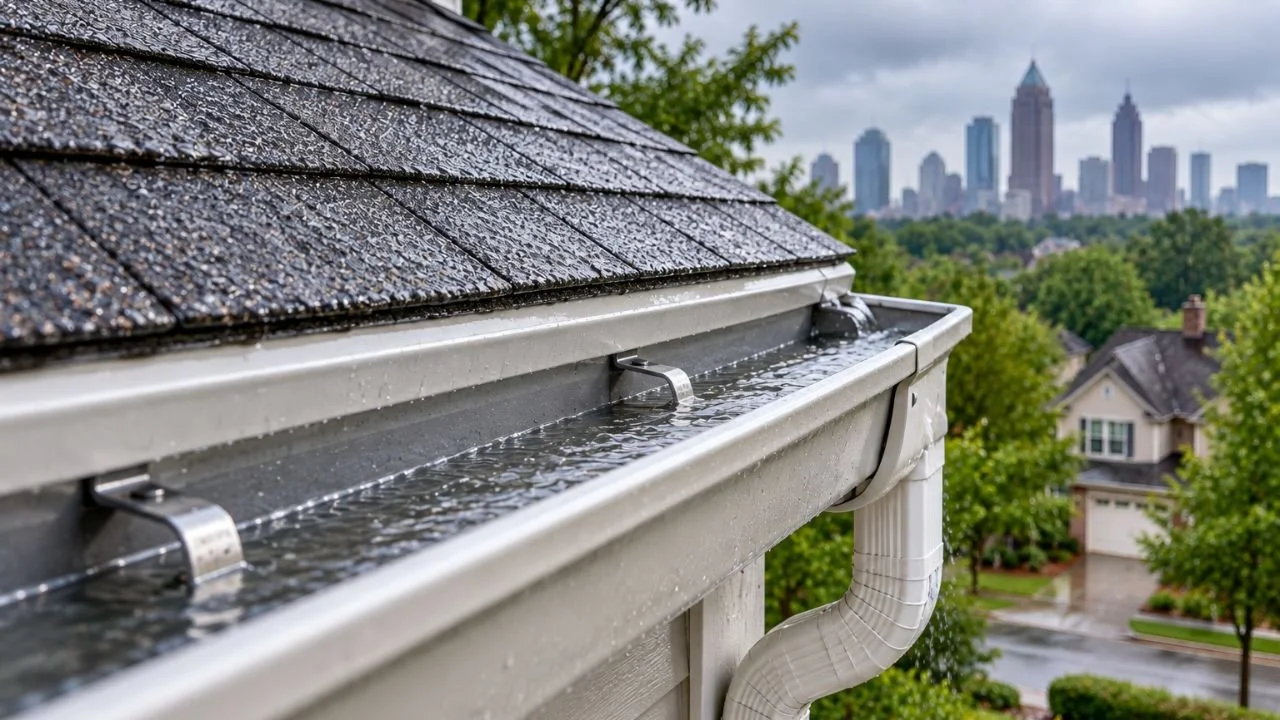
Gutter slope is the slight drop that helps rainwater move toward the downspout. A common starting point is about 1/4 inch of fall for every 10 feet of gutter. It is such a small tilt that you may not see it from the driveway.
You will notice when something is wrong, though. Maybe one section still holds water the morning after a storm. Or water pours over the same corner every time Atlanta or nearby areas get heavy rain. Both can point to a pitch problem, but don't blame the slope just yet. A clog, loose hanger, blocked downspout, or poor gutter size can look very similar.
Here is how to tell what may be going on.
What Is the Correct Gutter Slope?
Your gutters may look level, but they should not be perfectly flat. They need a small drop toward the downspout so gravity can move the water. A widely used guideline is 1/4 inch of fall for every 10 feet. Some homes and gutter systems may need a different setup based on roof design, rainfall, gutter size, and downspout placement.
Here is what the common 1/4-inch guideline looks like:
| Gutter Run | Approximate Total Drop |
|---|---|
| 10 feet | 1/4 inch |
| 20 feet | 1/2 inch |
| 30 feet | 3/4 inch |
| 40 feet | 1 inch |
| 50 feet | 1 1/4 inches |
If you work in metric measurements, that baseline equals about 2.1 mm of gutter slope per metre. So why does such a tiny drop matter? Water needs somewhere to go. With too little fall, it can sit in the channel. If the pitch runs the wrong way, water may move away from the downspout instead. The downspout layout matters too. Long gutter runs may need more than one downspout rather than one long, steep pitch.
Why Gutter Slope Matters More Than It Looks
A gutter has a simple job. It catches roof runoff and sends that water toward the downspout. When the pitch is right, you probably never think about it. Rain falls, the system drains, and life goes on.
A bad pitch is different. Water can sit in one spot and collect leaves and grit. A sagging section can get worse as it holds more water. Overflow may also send water down the siding or onto the ground beside your home. Still, poor pitch is only one possibility. If your gutters overflow, check for leaves and blocked downspouts too. There is little point changing the angle of a gutter when a clump of wet leaves is blocking the outlet.
5 Signs Your Gutter Slope May Be Wrong
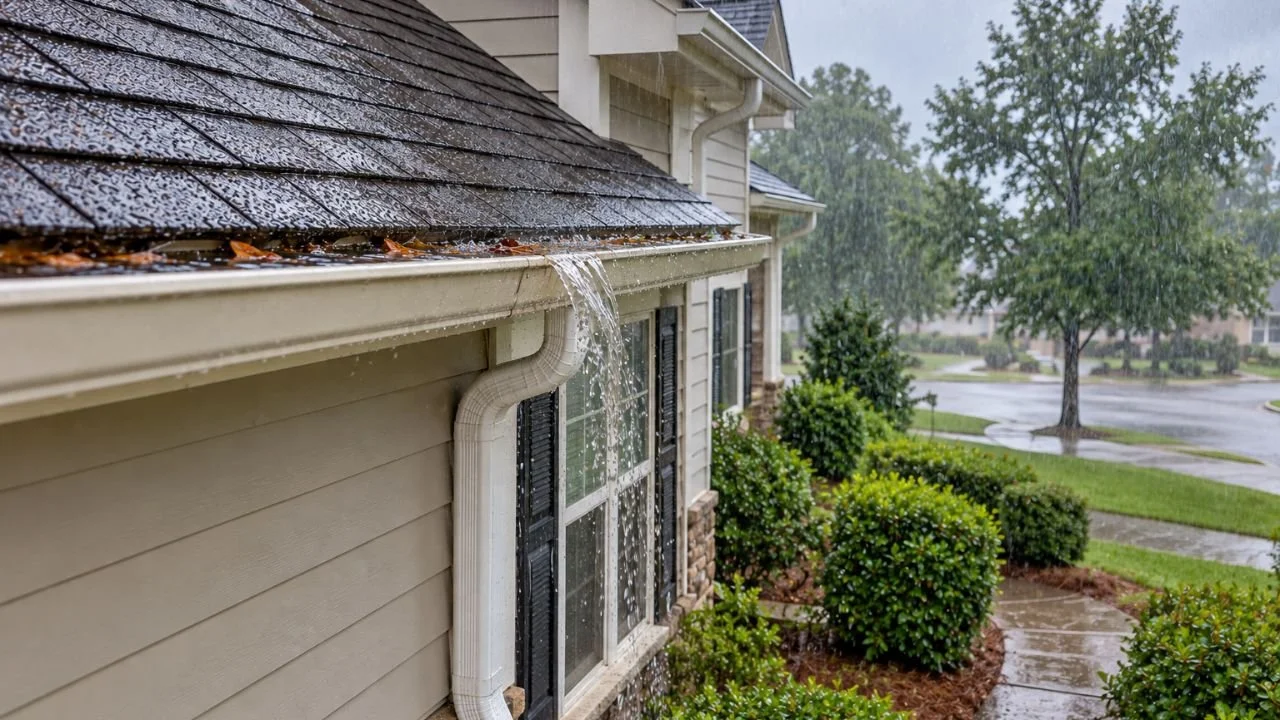
The easiest time to spot trouble is during rain or shortly after it stops. You do not need to climb onto the roof. In fact, you can learn quite a lot by standing back and watching where the water goes.
1. Water Sits in the Gutter After the Rain Stops
This is one of the easier clues to spot. Say the rain ended last night. Your driveway is dry by breakfast, but you can still see water sitting in one part of the gutter. That section may be too flat or have a low spot.
Look at where the water sits. If it always collects in the same place, a sagging hanger may be part of the problem. A little water does not prove the pitch is wrong. But a gutter that repeatedly turns into a shallow puddle deserves a closer look.
2. Water Keeps Pouring Over One Section
This often shows up during a hard storm. One part of the gutter works fine. Then you look a few feet down and see water spilling over the edge. It is tempting to blame the pitch straight away, but first look at the pattern.
Ask yourself:
Overflow near the downspout? Check for a blocked outlet.
Overflow in the middle? Look for a sag or low point.
Overflow along most of the gutter? Capacity or heavy debris may be the issue.
Water moving away from the outlet? The pitch may run the wrong way.
This small bit of detective work matters. Overflow has several causes, and changing the pitch will not fix all of them.
3. The Gutter Has a Visible Dip
Walk across the yard and look back at the roofline. Does the gutter follow one smooth line? Or does the middle seem to hang lower? That dip matters because water tends to settle there. Loose or damaged hangers can let a gutter sag over time. Once a low spot forms, water and debris have an easy place to collect.
Do not focus only on the angle. Check the condition of the gutter too. If it is pulling away from the fascia or badly damaged, simply changing the pitch may not be enough.
4. Water Moves Away From the Downspout
You do not need a tape measure to know this is a problem. Water should travel toward the outlet. If it moves toward the closed end, the gutter may be back-pitched. A light rain can actually make this easier to see. Watch the flow from the ground. You may notice water slowing down, stopping, or collecting before it reaches the downspout.
If the gutter has two downspouts? The setup may have a high point between them, with each side draining toward its nearest outlet.
5. The Same Area Below the Gutter Is Always Wet
Sometimes you notice the problem on the ground first. One flower bed keeps getting washed out. Mulch moves after every big storm. You may also see splash marks or a puddle below the same part of the roof. Look up. If water keeps escaping from that section, the gutter system needs attention. The cause could be poor pitch, a leak, a clog, or too much water for the gutter to handle.
This is especially worth watching during a strong Atlanta downpour. A small drainage weakness that stays hidden during light rain can become quite obvious when a lot of water reaches the gutter at once.
Is Your Gutter Too Flat or Too Steep?
More slope does not automatically mean better drainage. Too little pitch can leave standing water, while too much can create its own drainage problems.
Here is a quick way to read what you see:
| What You Notice | What May Be Happening |
|---|---|
| Water remains after rain | Gutter may be too flat or sagging |
| Water moves away from downspout | Pitch may run the wrong way |
| Water gathers in one spot | Low point or loose hanger |
| Gutter looks sharply tilted | Pitch may be too steep |
| Water repeatedly spills over | Check pitch, clogs, outlet, and capacity |
How to Check Gutter Slope at Home
Start on the ground. The next time it rains, watch whether water moves toward the downspout. Then check the gutter again after the storm. If water remains in one section, make a note of where it sits. You can also use a garden hose to watch how water travels through the gutter, provided you can do so safely. Water should move toward the outlet rather than staying in a low spot.
Measuring the actual pitch takes a little more work. For example, a 30-foot run using the common 1/4-inch-per-10-foot guideline needs about 3/4 inch of total fall from its high point to its low point. But don't take a risky ladder climb just to confirm a measurement. If the gutter is high, damaged, or hard to reach, that job is better left to someone with the right equipment.
Should You Re-Pitch, Repair, or Replace the Gutter?
This is where the decision becomes more practical. If the gutter itself is sound, correcting the pitch may be enough. A contractor may be able to reset the hangers and restore the proper fall toward the downspout.
But look at the rest of the system first. A badly bent gutter, pulling away from the fascia, leaking at several points, or sagging in several areas may need more than a pitch adjustment. The downspouts and outlets should also be checked. Sometimes the fix is much simpler. If wet leaves have packed the outlet, cleaning may restore normal flow without changing the pitch at all.
The goal is not to “fix the slope.” It is to find out why the water is not draining well and fix that problem.
Gutter Slope Problems in Atlanta Homes
Atlanta weather can put a gutter system to the test. A setup that seems fine in light rain may struggle once water starts coming off the roof fast. That is why pitch should not be checked on its own. Gutter size, downspouts, debris, hangers, and the final drainage point all matter too.
If water keeps pooling or spilling and you cannot find the cause, our team at National Gutter Alliance can take a closer look. Our gutter cleaning and gutter installation services can help address the real cause, whether it is a blockage, poor drainage, or a gutter system that needs replacing. A clogged system may simply need a thorough cleaning, while damaged or poorly set gutters may need more work.
The next time Atlanta gets a good rain, watch your gutters for a few minutes. If water sits, spills, or heads the wrong way, don't keep guessing. Find the cause first, then fix what is actually stopping the water from getting where it needs to go.
FAQs About Gutter Slope
What is the proper slope for gutters?
A common guideline is 1/4 inch of fall for every 10 feet of gutter, sloping toward the downspout. The exact setup may vary with the home and gutter system.
What is the gutter slope per metre?
The 1/4-inch-per-10-foot guideline works out to roughly 2.1 mm of fall per metre.
Can gutters have too much slope?
Yes, more pitch is not always better. Excessive pitch can affect how the gutter handles water and can make the gutter look noticeably tilted.
Can you fix the gutter slope without replacing the gutters?
Often, yes. If the gutter and fascia are still in good shape, the hangers may be repositioned to correct the pitch. Damaged or badly sagging gutters may need more extensive repair or replacement.
How do I know if the slope is wrong or the gutter is clogged?
Start by checking where the problem happens. Water backing up near an outlet often points to a clog. Water repeatedly sitting in the same clear section can point to a low spot or poor pitch.
